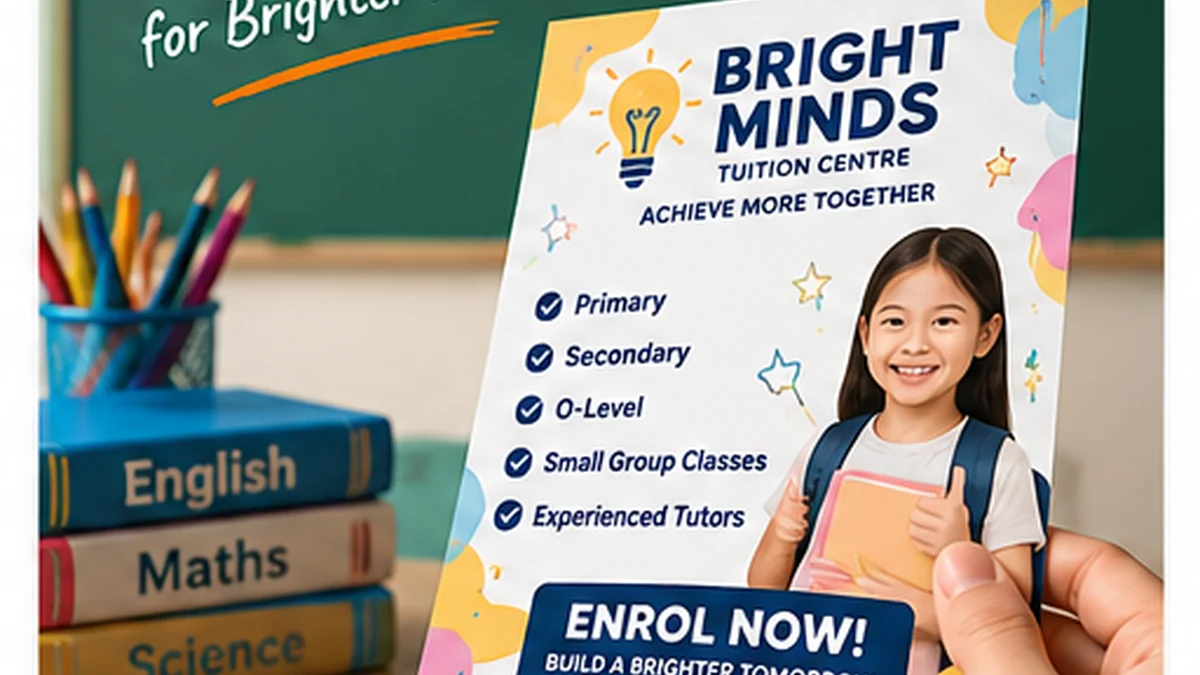
Tuition Centre Flyer Printing: How to Create Effective Student Recruitment Flyers
For tuition centre flyer printing, keep the message focused on the programme, target level, key benefit and next action. A5 is a practical all-round size, while 80gsm woodfree is economical for mass distribution and 105gsm to 157gsm gloss art paper gives a more promotional feel.
For current specifications, turnaround guidance and quotation details, see our flyer printing in Singapore page.
Why tuition centre flyers still work
Parents often compare several enrichment, tuition and academic support options before making an enquiry. A printed flyer gives a tuition centre a compact way to present its subjects, levels, location, programme benefits and contact route in one physical piece.
You can compare this with our printing services in Singapore and use the artwork guide before submitting files.
Flyers can support open houses, neighbourhood campaigns, school-holiday programmes, trial lessons, new-branch launches and seasonal enrolment drives. They are most effective when the message is simple enough to understand in a few seconds.
Start with one clear recruitment objective
Do not try to advertise every programme at equal importance. Decide whether the flyer is mainly promoting a new intake, a specific subject, a holiday programme, a trial lesson or a new centre location.
A clear objective makes the headline stronger and helps you decide what information deserves space. The flyer should lead naturally from headline to benefit to proof to action.
What information should a tuition centre flyer include?
Include the tuition centre name, programme or subject, student level or age group, a concise benefit, location or service area, contact details and a clear call to action. A QR code can link directly to WhatsApp, a registration form, class schedule or landing page.
If there is a limited-time offer, make the deadline obvious. If trial lessons are available, state the terms clearly rather than hiding them in small text.
Choose the flyer size based on the amount of information
A5 is popular because it provides enough room for a strong headline, several key points and a clear CTA while still being convenient for handouts and letterbox distribution. A6 works for shorter messages and simple promotions. A4 provides more space for programme tables, multiple subjects or detailed schedules.
If the content is becoming too dense, consider a folded brochure or a separate programme sheet instead of reducing every font size.
Paper choice affects both cost and presentation
For large neighbourhood campaigns, 80gsm woodfree can keep the cost practical. 105gsm and 128gsm gloss art paper provide a smoother surface and stronger promotional feel. 157gsm gloss is more substantial and can work well for smaller premium campaigns or counter handouts.
Paper should match the campaign. A mass-distribution flyer does not need the same material as a premium information piece used during consultations or open houses.
Use design hierarchy to make the flyer easier to scan
The headline should be immediately visible. Course level, key benefit and CTA should follow in a clear order. Avoid filling the flyer with too many different fonts, shapes and colours.
Parents should be able to identify what the programme is for, who it is for and what to do next without reading every line. Use white space deliberately so the important information is not buried.
Check QR codes, mobile numbers and registration links
Tuition campaigns often rely on a QR code or WhatsApp enquiry. Scan the QR code from the final artwork and test the landing page. Check all phone numbers, dates, fees and programme details before approving production.
If the flyer includes a map or address, confirm that it is current and readable at the final printed size.
Plan printing and distribution as one campaign
If flyers will be distributed around nearby estates, shopping areas or community locations, confirm the target coverage before finalising the print quantity. Include additional copies for the centre, events, parent referrals and follow-up use.
For a larger campaign, keeping one approved master PDF helps prevent different versions from being printed or distributed by mistake.
Frequently Asked Questions
What size is suitable for tuition centre flyer printing?
A5 is a popular all-round size because it provides space for course details while remaining easy to distribute. A6 is useful for concise promotions, while A4 suits information-heavy flyers.
What paper should a tuition centre use for flyers?
80gsm woodfree suits economical mass distribution, while 105gsm to 157gsm gloss art paper provides a smoother promotional finish. The best option depends on budget, quantity and how the flyer will be used.
What should be included on a tuition centre flyer?
Include the centre name, programme or subject, level or age group, key benefit, location or service area, contact details, a clear call to action and any relevant QR code or registration link.
Can tuition centre flyers be printed for urgent campaigns?
Selected same-day or next-day production may be possible when artwork is ready and the required paper, quantity and production slot are available.
Useful next steps: Flyer Printing Singapore · Leaflet & Pamphlet Printing · Flyer Distribution Singapore · Artwork Guide